
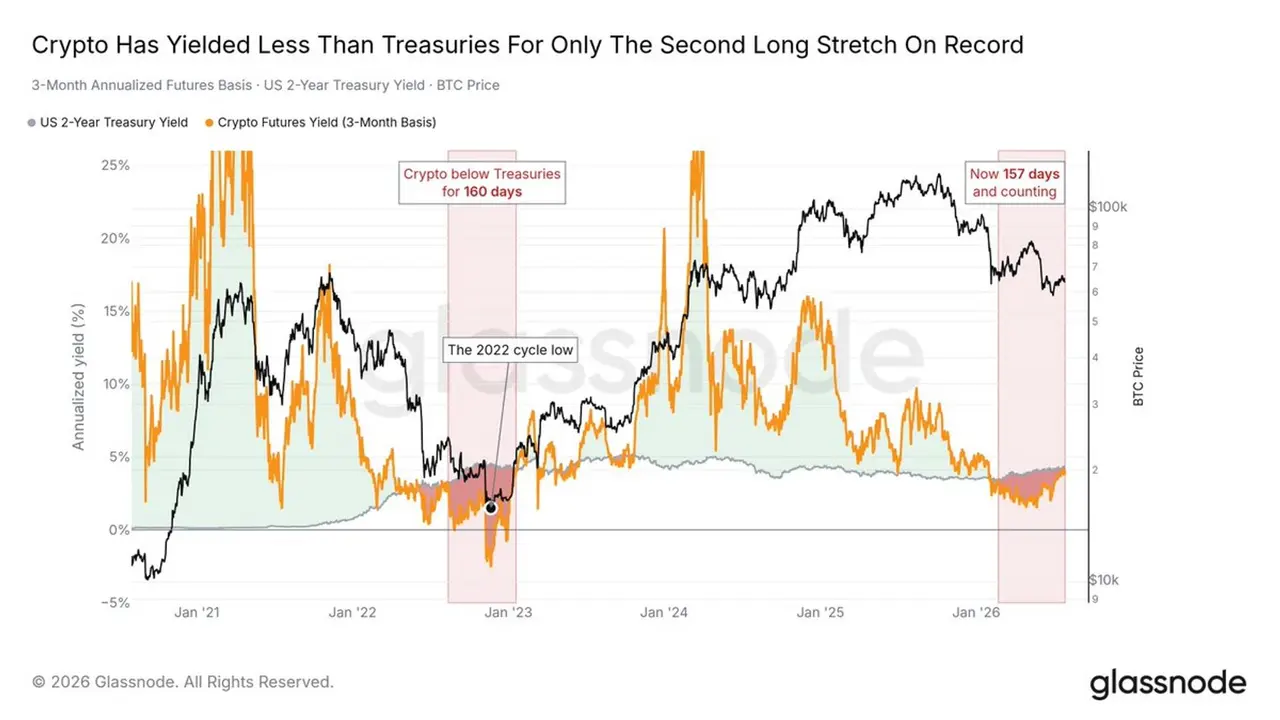
Bitcoin's once-lucrative futures carry trade has all but vanished, with annualized yields on quarterly contracts now trailing what investors can earn on plain two-year U.S. Treasury notes — a dramatic reversal from the double-digit returns that defined the market just a couple of years ago.
From 20% Yields to Bond-Beating Nothing
The basis trade, a strategy that exploits the price gap between bitcoin's spot price and its futures contracts, was once one of the most reliable ways to generate outsized returns in crypto. At its peak, the annualized yield on quarterly bitcoin futures exceeded 20%, drawing in hedge funds, market makers, and institutional traders eager to capture the spread with minimal directional risk.
That premium has now evaporated. Since February, the yield on quarterly futures has consistently lagged behind the roughly 4% offered by two-year Treasuries, effectively erasing the incentive that once powered the trade. Where traders once collected rich rewards for selling futures against spot holdings, the math no longer works in their favor.
When bitcoin futures pay less than government bonds, the era of easy carry is over.
A Sign of a Maturing Market
The collapse in futures yields reflects a broader shift in the digital asset landscape. Shrinking arbitrage opportunities are typically a hallmark of markets becoming more efficient, with fewer price dislocations left for traders to exploit. As institutional participation has deepened and liquidity has improved, the wild premiums that characterized earlier cycles have compressed.
Several factors help explain the decline:
- Greater institutional presence tightening spreads between spot and futures prices
- Broader access to spot bitcoin exposure through regulated products
- Reduced speculative leverage compared with previous bull runs
For traders, the vanishing carry means the days of harvesting eye-popping, low-risk yields from bitcoin's futures market appear to be behind them. What remains is a market that increasingly resembles traditional finance — more efficient, more institutional, and far less generous to those chasing arbitrage.
The shift also carries a message about where bitcoin stands in its evolution. A futures curve that no longer offers a fat premium suggests investors are no longer paying up for leveraged upside the way they once did, pointing to a market that has grown more measured and mature.