
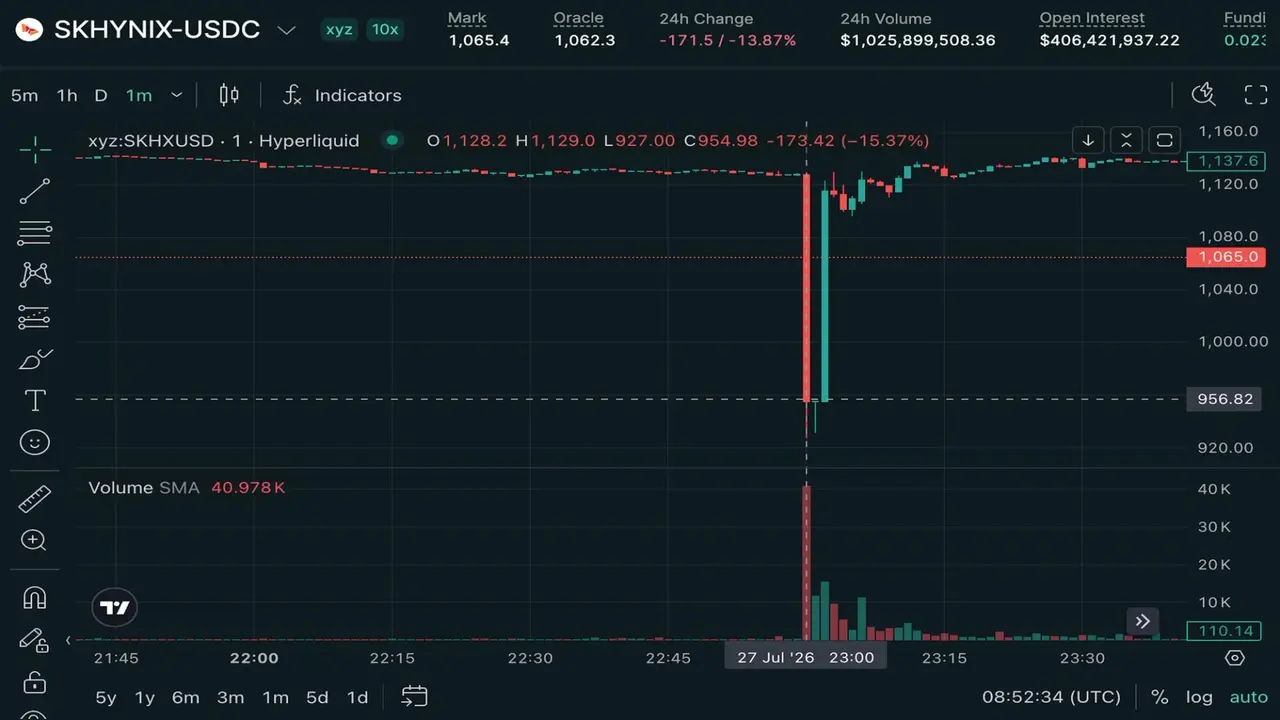
A newly launched perpetual futures contract tied to South Korean chipmaker SK Hynix suffered a violent flash crash on the decentralized exchange Hyperliquid, briefly plunging to $900 before snapping back above $1,000 within moments.
What Happened
The perpetual contract, which tracks the American depositary receipts of SK Hynix, dropped roughly 20% in the span of a single minute. The sudden collapse triggered a wave of liquidations before the price rebounded almost as quickly as it had fallen, leaving the contract trading back above the $1,000 mark.
Flash crashes of this kind have become a recurring feature of thinly traded derivatives markets, where a burst of selling or a cascade of liquidations can overwhelm available liquidity. In this case, the swing was over almost as soon as it began, but not before catching traders on the wrong side of leveraged positions.
A 20% drop in 60 seconds is a stark reminder of how fragile liquidity can be for newly listed products.
Tokenized Equities Meet DeFi
The episode underscores the growing trend of bringing traditional equities onto blockchain-based trading venues. By offering perpetual futures linked to real-world stocks like SK Hynix, platforms such as Hyperliquid are blurring the line between conventional finance and decentralized markets.
Perpetual futures allow traders to bet on price movements without an expiry date, and they typically employ significant leverage. That leverage amplifies both gains and losses, making sudden price dislocations especially punishing for participants who are not carefully managing risk.
Key considerations for traders eyeing these products include:
- Thin liquidity that can magnify sudden price swings
- High leverage that accelerates liquidations
- The novelty of equity-linked perpetuals on decentralized platforms
For now, the SK Hynix contract has stabilized, but the incident serves as a cautionary tale about the risks embedded in emerging tokenized equity markets on decentralized exchanges.