
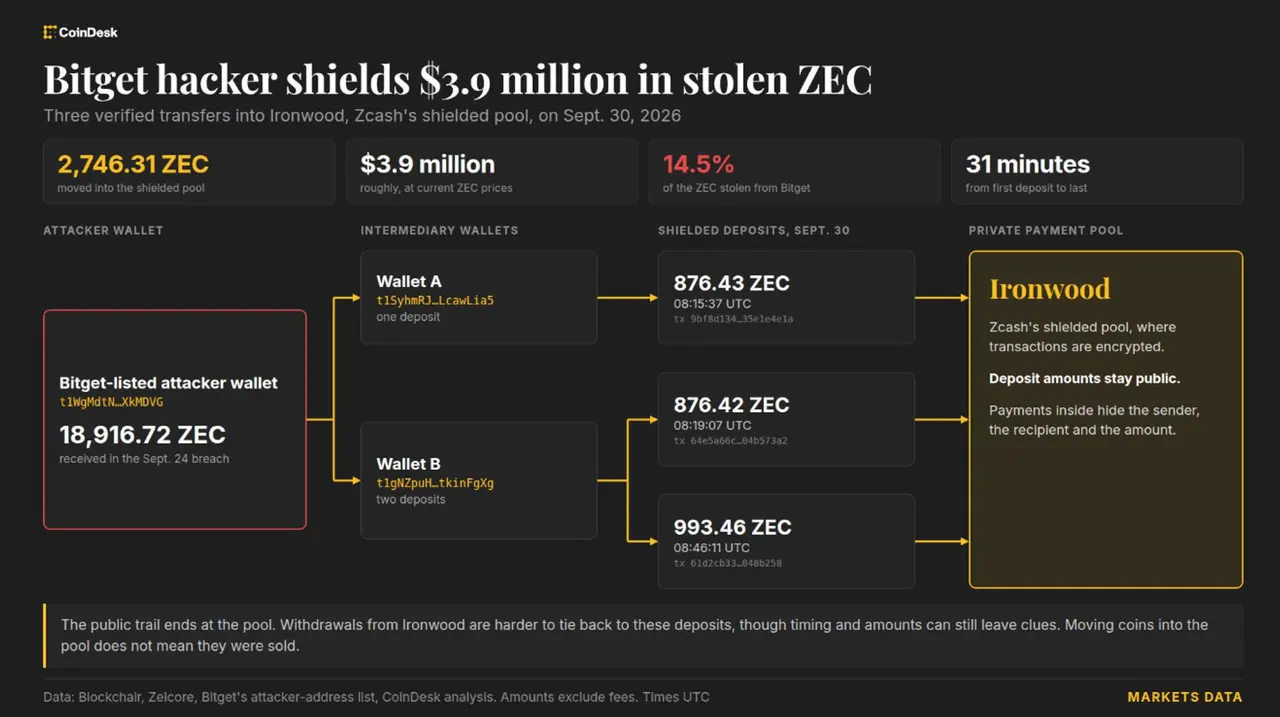
Hackers who breached the crypto exchange Bitget have shifted roughly $4 million worth of stolen Zcash into the network's privacy-focused shielded pool, a move that significantly complicates efforts to track the pilfered funds.
The Move Into Zcash's Shielded Pool
According to blockchain observers, the attackers executed three separate transfers that funneled about 15% of the stolen ZEC into Ironwood, Zcash's private transaction environment. Unlike transparent blockchain transactions, payments routed through this shielded pool conceal the sender, the recipient and the amount being sent, effectively cloaking the money trail from investigators and analytics firms.
The tactic represents a deliberate escalation in laundering methods. By leveraging Zcash's cryptographic shielding, the hackers gain a layer of anonymity that standard transparent chains simply cannot provide, making it far harder to follow the flow of assets once they enter the pool.
Once funds slip into Zcash's shielded pool, the trail investigators depend on effectively goes dark.
Why It Matters for Tracing Stolen Funds
Privacy coins have long been a preferred vehicle for actors seeking to obscure the origins of illicit proceeds. Zcash's shielded transactions strip away the on-chain visibility that blockchain analytics tools rely on, meaning that only the portion of funds still sitting on transparent chains remains readily traceable.
The remaining roughly 85% of the stolen ZEC has not yet been shielded, leaving a window for exchanges, law enforcement and analytics providers to flag or freeze assets before they too disappear into the private pool. Speed is critical, as each additional shielded transfer chips away at the recoverability of the funds.
- Three transfers moved about 15% of the stolen ZEC into the shielded pool
- Shielded transactions hide sender, recipient and amount
- The bulk of the stolen tokens remains on transparent chains for now
The incident underscores the persistent tension between financial privacy technology and the need to trace criminal proceeds, a debate that grows sharper each time a major hack leverages privacy-preserving tools to launder its haul.